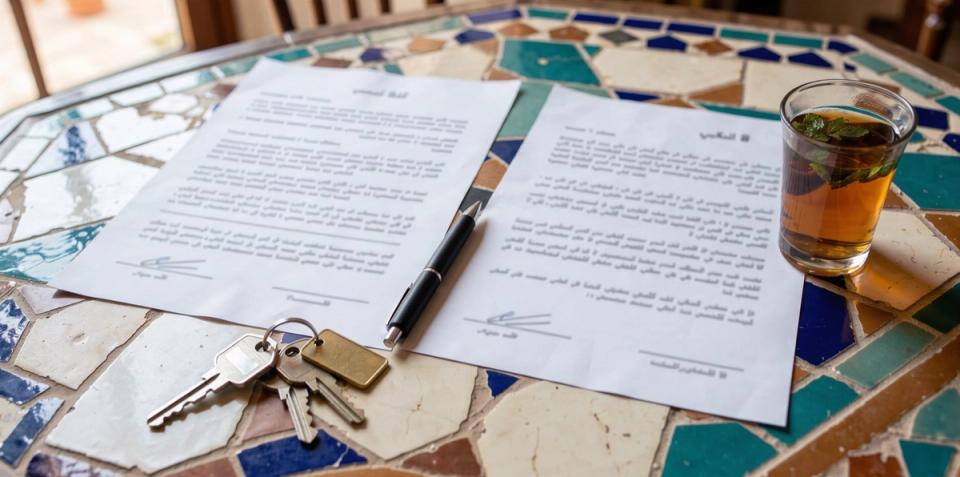
Tenant, rent, lease: in Morocco, rental contracts are written in Arabic, in French or in both, and law no. 67-12, which governs residential leases, uses precise wording. This glossary gives each term you will meet from the first viewing to handing back the keys, in English, in French, in Arabic (the wording of the law) and in Darija where everyday usage differs, with a plain explanation.
Looking for the documents themselves? Our lease, rent receipt, inventory and termination letter templates can be downloaded for free, in French and Arabic.
Tenant, rent, lease: the 3 words to know in Arabic
- Tenant (locataire) in Arabic: المكتري. This is the word used in law 67-12. You will also see المستأجر in standard Arabic, and الكاري in Darija.
- Rent (loyer) in Arabic: الوجيبة الكرائية. This is the legal term. In everyday speech, rent is الكراء, or الكرا in Darija; in standard Arabic, الإيجار or الأجرة.
- Lease (bail) in Arabic: عقد الكراء. A lease agreement (contrat de bail) is عقد الكراء in Moroccan law and عقد الإيجار in standard Arabic; in Darija people often just say “the contract” (الكونطرا).
Good to know: Moroccan law uses the root كرى (to rent) rather than أجّر, which is more common in the Middle East. In a Moroccan lease you will therefore read المكري (landlord) and المكتري (tenant) rather than المؤجر and المستأجر.
The people involved
- Landlord (bailleur): المكري — Darija: مول الدار. The person who lets the home.
- Tenant (locataire): المكتري — Darija: الكاري. The person who lives in the home and pays rent.
- Agent with power of attorney (mandataire): الوكيل. Signs or manages the rental on the landlord's behalf.
- Guarantor (garant): الكفيل. Agrees to pay if the tenant does not. Law 67-12 does not require one: it is a clause of the contract.
- Estate agency (agence immobilière): الوكالة العقارية — Darija: السمسار for a broker. Finds tenants, arranges viewings and can manage the property.
- Bailiff (huissier de justice): المفوض القضائي. Serves official notices (notice to quit, formal demand) and can record findings.
- Building manager (syndic): وكيل اتحاد الملاك — Darija: السانديك. Runs the common areas; the fee is often part of the service charges.
The lease agreement: عقد الكراء
- Lease agreement (contrat de bail): عقد الكراء. It must be in writing with a certified date (article 3 of law 67-12). It states who the parties are, the home and its fittings, the rent, the charges, how payment is made and each side's obligations.
- Certified date (date certaine): ثابت التاريخ. The date of the contract must be indisputable. In practice this is done by certifying the signatures or through a notary or adoul deed.
- Signature certification (légalisation): تصحيح الإمضاء. Done at the local council office (المقاطعة) with your national ID card or passport.
- Furnished / unfurnished (meublé / vide): مؤثث / غير مؤثث — Darija: مفروشة / خاوية. Law 67-12 covers both, for any rental longer than 30 days (article 1).
- Lease term (durée du bail): مدة الكراء. Freely agreed. But a residential lease does not end automatically when the term expires: a notice is required under the conditions of the law (article 44).
- Automatic renewal (tacite reconduction): التجديد الضمني. The lease carries on under the same terms until someone ends it.
- Subletting (sous-location): تولية الكراء; assignment (cession): التخلي عن الكراء. Not allowed without the landlord's written consent, unless the lease says otherwise (article 39).
- Sale of the property: انتقال الملكية. The lease continues with the new owner on the same terms (article 4).
For the clauses in detail, read our complete guide to rental contracts in Morocco.
Money: rent, charges and deposit
- Rent (loyer): الوجيبة الكرائية — Darija: الكرا. The amount due on the date set in the contract (article 12).
- Service charges (charges locatives): التكاليف الكرائية. Building or utility costs (syndic, water, electricity…) paid on top of the rent when the contract says so.
- Deposit (dépôt de garantie): الضمانة. Capped at two months' rent and returned no later than one month after the keys are handed back, minus any sums owed and proven (article 20).
- Advance rent: التسبيق. Months of rent paid upfront at signing; not the same thing as the deposit.
- Rent receipt (quittance de loyer): وصل الكراء — Darija: الوصل. The landlord must give a signed receipt that separates rent and charges (article 11).
- Rent review (révision du loyer): مراجعة الوجيبة الكرائية. No increase within three years; without an agreement between the parties, the increase is capped at 8% for a home (articles 32 to 34).
- Agency fee (commission): العمولة — Darija: السمسرة. The broker's fee, freely agreed.
Letting your property? See also how to set the rent in Morocco.
Inventory and upkeep
- Inventory / condition report (état des lieux): البيان الوصفي. A detailed description of the home drawn up by both parties at move-in and move-out and attached to the lease (article 7). The law asks you to avoid vague wording such as “good condition” or “average condition” (article 8).
- Without an inventory, the tenant is presumed to have received the home in usable condition (article 8), which makes earlier defects hard to prove.
- Handing over the keys: تسليم المفاتيح — Darija: السوارت. Marks move-in and move-out.
- Meters: العدادات. Write down the water (الماء) and electricity (الكهرباء) readings at move-in and move-out.
- Tenant repairs (réparations locatives): الإصلاحات. Small everyday repairs are the tenant's job: doors, windows, glass, locks, sockets, interior paint, taps (article 19).
- Maintenance and major repairs: الصيانة. The landlord's job. If nothing is done within a month of being notified, the tenant can ask the court president for permission to carry out the work and deduct it from the rent (article 10).
- Wear and tear: حالة القدم; normal use: الاستعمال المألوف والعادي; force majeure: القوة القاهرة. The tenant is not liable for damage caused by these (article 14).
- Alterations: التغييرات. The tenant may not alter the home without the landlord's written consent (article 15).
Ending the lease
- Landlord's notice to quit (congé): الإشعار بالإفراغ. A written notice stating its grounds and giving the tenant at least two months (articles 45 and 46). Accepted grounds: taking the home back to live in, demolition or necessary works, late payment.
- Taking the home back to live in: استرداد المحل للسكن. For the landlord, their spouse, parents or children… The landlord must have owned the home for at least 18 months (article 49). When the notice is upheld, article 51 provides compensation equal to one year's rent plus moving costs.
- Tenant's notice (préavis): أجل الإخطار. Law 67-12 sets no notice period for the tenant: the contract does. Send your letter by registered post with acknowledgement of receipt (رسالة مضمونة مع إشعار بالتوصل).
- Termination by the court (résiliation): فسخ عقد الكراء. A judge can end the lease for misuse, unauthorised works, serious damage or unpaid rent despite a formal demand (article 56).
- Death of the tenant: وفاة المكتري. The lease continues for the spouse, children or parents who lived with the tenant (article 53). After a divorce it can continue for the mother who has custody of the children (article 54).
- Return of the deposit: رد الضمانة. No later than one month after the keys are handed back (article 20).
- Occupier without right or title: محتل بدون سند. A tenant who stays after the lease has ended owes compensation at least equal to the rent (article 13).
Unpaid rent and disputes
- Formal demand for payment (mise en demeure): الإنذار بالأداء. If rent is unpaid, the landlord asks the president of the court of first instance for leave to serve a formal demand; the tenant then has at least 15 days to pay (articles 23 to 25).
- Payment order (injonction de payer): الأمر بالأداء. If the tenant still does not pay, the court president confirms the demand and orders payment within 48 hours of the request (articles 26 and 27).
- Late payment: التماطل في الأداء. One of the grounds for a notice to quit (article 45).
- Eviction (expulsion): الإفراغ. Only a judge can order it; the landlord cannot change the locks on their own.
- Court of first instance: المحكمة الابتدائية. The court where the home is located has jurisdiction (article 71). For urgent matters: the summary judge, قاضي المستعجلات.
- Abandoned home: المحل المهجور. Emptied and closed for at least six months; the landlord can recover it by court order (articles 57 onwards).
To go further, read our article on the legal framework for renting in Morocco.
Put it into practice: download our free French / Arabic rental templates (lease agreement, rent receipt, inventory, termination letter) as PDF and Word.